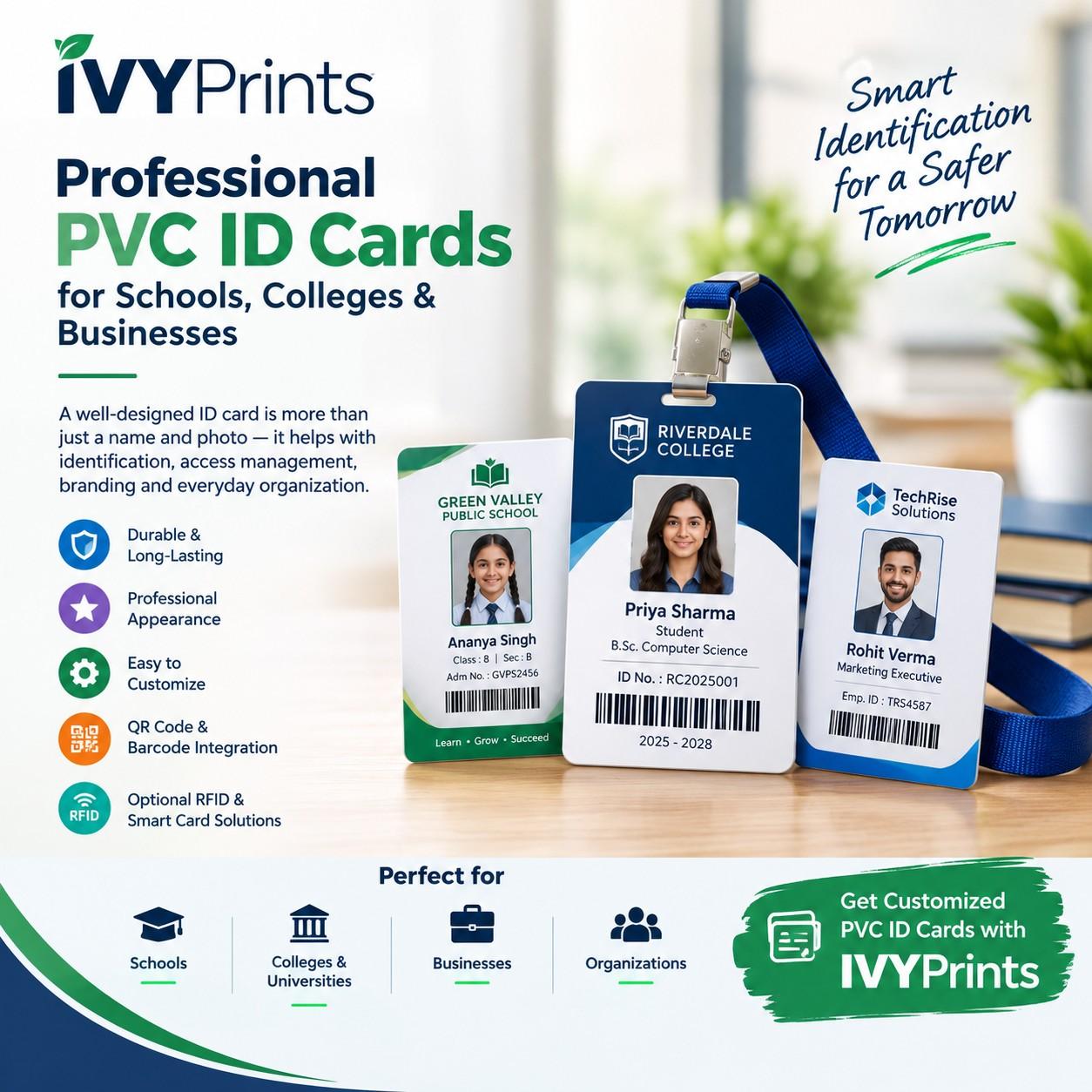
"Get durable PVC ID card printing services for schools, colleges and businesses. Explore custom designs, QR codes, barcodes and RFID options with IVYPrints. "
Introduction
A good ID card isn't just a name and photo. It can assist an institution to establish its members, to arrange access and to maintain uniformity of professional image. PVC cards are a useful hybrid of durability and clear printing and customization for organizations that require reliable PVC ID Card solutions. They can be issued to students and teachers in school, to students and staff in college, and to business professional employees and visitors.
PVC ID cards have become popular due to their regular usage. Properly made PVC card can be used everyday and can carry information like photos, names, identification numbers, departments, barcodes or QR codes that cannot be achieved with paper-based identification.
What Are PVC ID Cards?
PVC ID cards are ID cards made of the plastic PVC. Generally they are produced in a standard card format, though this may differ from application to application.
The ISO/IEC 7810 standard specifies the physical properties of identification cards such as size, structure and other specifications. The latest published version of ISO/IEC 7810:2019 was reviewed and confirmed in 2025.
Commonly found in a typical PVC ID card:
Organization/Institution Logo
Cardholder photograph
Full name
Student/Employee ID.
A student's course or department, or designation.
Contact/emergency information (if applicable)
Barcode or QR code
The date on which the document is no longer valid.
Signature area
Elements that relate to security or access.
The information should reflect the real intended use of the card. For instance, a school ID might need additional information to that of an employee access card.
Why Choose PVC ID Cards?
The foremost benefit of PVC is its practicality. ID cards are worn regularly in wallets, lanyards, scanned on access doors and may come into contact with moisture or wear and tear.
Use every day and don't throw it away.
PVC cards are better for everyday use than standard paper badges. They are made from plastic, which provides them with a strong finish and helps them to retain their shape under normal use.
This is a relevant issue for the school and college as the card can be used for the entire academic year. PVC cards for employees that are required for identification during their working hours can also be used by businesses.
Professional Appearance
An image, text and branding that is sharp and clear can make an ID look more professional. When designing the card, organizations may include their logo, branding colours and guidelines for how the card should look.
This is especially beneficial for companies that have staff members who can come into contact with customers, visitors or suppliers.
Easy to Customize
PVC cards can be developed based on the needs of the organisation. Groups may use varying formats and remain uniform.
For instance, a college could have a different card for students and a different card for faculty members, or a company could have a card for employees, contractors and visitors.
PVC ID Cards for Schools
Students, teachers and administrators frequently require identification cards in school. Student card can include basic student information along with other relevant and helpful information like class, section, admission number and school contact details.
A school ID card can be used for a variety of normal school activities:
Identifying students on campus
The distinction and categorization of students by class and/or department
Supporting attendance systems
Managing library access
Helping people sign up for events and activities.Registering people for events and activities.
Identifying authorised persons for staff
The information that should be included should be only as much as the school really needs. Don't put all the unnecessary personal information on a card just because there is space.
PVC ID Cards for Colleges and Universities
The requirements for identification may be more complicated for higher-education institutions. A college ID could be used to identify a student, associate with services like library or lab access, cafeteria or event access, etc.
A personalized college ID card can have:
Student photograph
A student registration number or enrollment number.
Course and department
Academic year
College logo
Barcode or QR code
Validity information
Smart-card or RFID optional.
If the card is being used with an electronic access system, the printing company and technology provider should make sure that the design of the card is compatible with the system.
PVC Employee ID Cards for Businesses
The simple answer to the question about the function of employee ID cards is that they are used to identify who is a part of an organization and who isn't.
A professional employee card can include the employee's photograph, name, designation, employee number, department and company branding. It can also be a QR code, barcode or technology-based credential, depending on the needs of the organization.
In offices where employees have to go through controlled spaces, ID cards may be helpful. The NIST guideline for physical access systems provides a definition of identity credentials as one part of access-control processes and cautions against the use of authentication based on the level of security required and risk involved in a facility.
Importantly, ID card is not enough to ensure security. It is associated in a broader identification and access-management process.
What Information Should a PVC ID Card Include?
No single layout will be suitable for all organizations. The correct design will depend on usage of the card.
Useful fields that can be included in a school include:
Student name
Photograph
Class and section
Admission number
Name of school, logo
Academic year
A college may include the following information on the card:
Student name
Photograph
Enrollment number
Course
Department
Academic year
Institution details
In a business, some common information is:
Employee name
Photograph
Employee ID
Designation
Department
Business name and logo.
Validity date
In an operational sense, a QR code or barcode may be added when there is a real operational need for the scanning of the card.
QR Codes, Barcodes and RFID Options
It's possible to use modern ID cards for more than just printed data.
QR Codes
A QR code may link the physical card either to digital information or to a built-in verification system. The use of it should be carefully considered to ensure the information conveyed by the code is suitable for the intended audience.
Barcodes
Barcodes may be helpful if an organization already has a barcode system for attendance, library, or inventory.
RFID and Smart Cards
If the institution needs contactless identification or access, it could consider an RFID or smart-card solution. These cards combine technology with a print on them.
The selection of the chip or inlay, however, should be made depending on the reader, environment of use and application. A card that is printed with an RFID symbol alone will not automatically work with an access-control system.
How PVC ID Card Printing Works
The printing process normally starts with gathering the essential information and developing a card design. The typical workflow is:
1. Requirement Collection
The organization supplies info including size of the card, number of cards, necessary field, logo, photographs and any barcode or QR or RFID needs.
2. Card Design
A digital design is created taking into account readability, branding and information hierarchy.
3. Data Preparation
The names, photographs, identification numbers and other information for bulk orders is arranged into a structured data file. This not only decreases repetitive manual entry but also simplifies data management.
4. Printing
A suitable PVC card stock is used with an appropriate card-printing process to print the card artwork.
5. Quality Check
Print quality, barcode / QR readability, photographs, alignment, colour consistency and spelling should all be checked on cards.
6. Finishing and Delivery
Cards may be provided with accessories (such as lanyards, card holders or clips), depending on the sequence.
How to Choose a PVC ID Card Printing Service
When choosing a printing company, there are more elements to consider than price. Businesses should take the whole manufacturing procedure into account.
Be sure to find a provider who can provide you with:
Print Clearly and in a consistent font.
Accurate personalization
Bulk-order capability
Design assistance
QR/barcode integration
Provide RFID or smart-card options as appropriate
Quality control for proof before printing.
Quality control
Appropriate packaging and packaging transport
Responsive customer support
If ordering cards for large school or corporate use, inquire about data accuracy and replacement cards. This helps avoid delays caused by a single mistake, made in hundreds of cards.
IVYPrints for Custom PVC ID Card Printing
IVYPrints offers special printing services for educational institutions, businesses and organizations. Its ID card features can be customized to meet various needs such as student ID, school ID, college ID, employee ID, teacher ID, visitor ID and technology-based card solutions.
The emphasis should not just be on printing a plastic card. The best ID-card service offers a design that meets the needs of the organization, high-quality personalization and printing, and the ability to handle the volume of cards they need.
For institutions placing bulk orders, it's easier to work with a provider who is familiar with the printing and personalization portion of the process. IVYPrints also applies this customization approach into education and technology related print jobs and therefore comes across a wide spectrum of printing needs.
Final Thoughts
PVC ID cards are an excellent way for schools, colleges and businesses to get a card designed for everyday use. Their utility is more than the actual plastic—the information on the card becomes readable when good card design is achieved, and when designed to make use of features like QR codes, barcodes and RFID, their value becomes more.
Organizations should determine their end goal for the card before ordering it, as well as what information is needed and if there is a need for any technology-based features. The printing provider can then suggest an ideal method for producing the cards as well as an appropriate design.
If your school, college or business is looking for a new batch of ID cards, then having a provider that can manage the entire design, personalisation, printing and quality control process can make the entire process easier.
Frequently Asked Questions
Are PVC ID cards suitable for schools?
Yes. PVC cards are commonly suited to student, teacher and staff identification because they are designed for regular handling and can accommodate photographs, text, barcodes and QR codes.
Can PVC ID cards include QR codes?
Yes. A QR code can be incorporated into the card design when the organization has a suitable digital use or verification system.
Can employee ID cards include RFID?
Yes. RFID-enabled cards can combine printed employee information with contactless technology, provided the card's RFID technology is compatible with the organization's readers and access system.
What size is a standard ID card?
The ISO/IEC 7810 ID-1 format is nominally 85.60 mm × 53.98 mm.
How long do PVC ID cards last?
Their usable life depends on card construction, printing method, frequency of handling and storage conditions. For schools and businesses, the required replacement cycle should be based on actual usage and the organization's validity period.
What should I check before approving a bulk ID card order?
Check names, photographs, identification numbers, departments, dates, logos, spelling, colors and machine-readable elements such as QR codes or barcodes. A final proof check can prevent repeated errors across a large batch.